
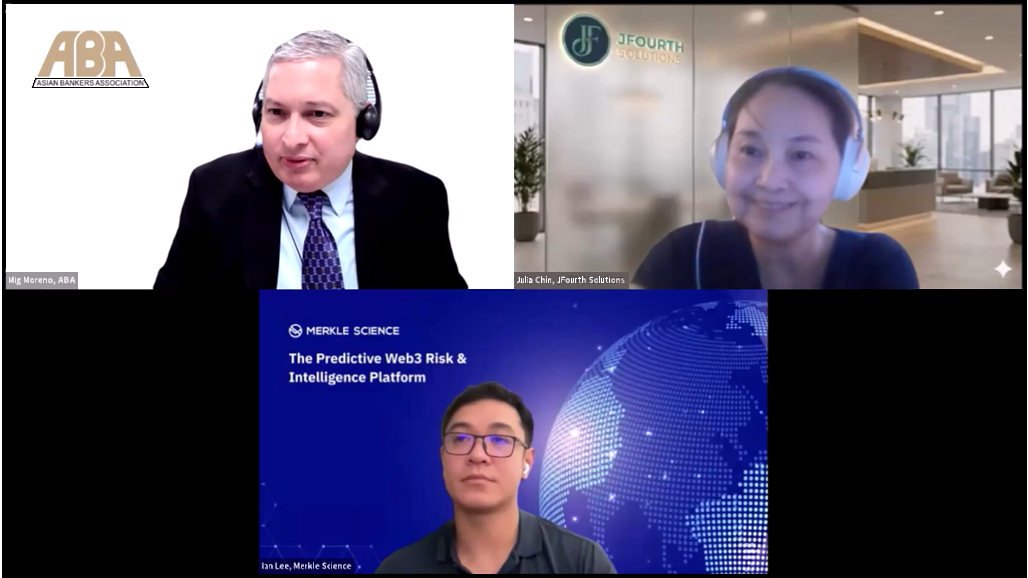
On 26 March 2026, the Asian Bankers Association held a webinar on “Tokenization 101 for Banks: New Assets, Faster Cash Flows and Real Revenue” with the participation of 300 registered participants.
Hereunder is a summary report on the webinar.
(1) Welcome Remarks
Mig Moreno, ABA Deputy Secretary-Treasurer, opened the webinar by highlighting the rising importance of tokenization for banks in Asia. He noted that while tokenization—covering bonds, real estate, and trade finance—is gaining traction globally, many banks remain unsure how to start.
He described tokenization as a transformational shift with potential impacts on balance sheets, noting early adopters are already realizing benefits such as new revenue streams, faster settlement, and access to illiquid assets. Regulators are increasingly engaged, signaling a maturing ecosystem.
Moreno emphasized that banks must prioritize internal capability-building, possibly including dedicated units, and introduced the speakers, Julia Chin (compliance) and Ian Lee (blockchain and capital markets), encouraging active participation from attendees.
(2) The Opportunity: RWA Use Cases for Commercial Banks by Ian Lee
Ian Lee, Crypto & AML Forensic Advisor at Merkle Science, defined tokenization as representing real-world assets as digital tokens on blockchain, building on existing financial digitization like electronic transfers and dematerialized securities. Blockchain introduces faster settlement, transparency, and programmable assets via smart contracts, embedding compliance directly into transactions.
Tokenization applies to various assets, including securities, real estate, trade finance, and alternative assets. Stablecoins illustrate large-scale adoption, while fractional ownership in trade finance and funds improves liquidity and investment opportunities.
Lee highlighted tokenization’s role in an AI-driven financial ecosystem, enabling autonomous transactions and reducing friction. He stressed strategic implementation through education, targeted pilots, and defined use cases rather than large-scale rollouts.
Key Takeaways:
- Tokenization digitizes real-world assets on blockchain, extending financial digitization
- Benefits include faster settlement, transparency, programmability, and embedded compliance
- Stablecoins and trade finance lead adoption; fractional ownership expands liquidity
- Banks should focus on education, pilot projects, and clear use cases
(3) The Safeguards: Risk, Compliance, and Internal Readiness by Julia Chin
Julia Chin, JFouth Solution CEO, emphasized that tokenization transforms risks rather than eliminating them. Banks must invest in education and internal capabilities to manage these risks responsibly. Regulatory frameworks vary across Asia, complicating cross-border operations, and core compliance—KYC, AML/CFT, sanctions—must extend on-chain to wallets and token monitoring.
Legal and operational risks include security classification, smart contract governance, custody of private keys, and operational dependencies like blockchain infrastructure and oracles. She stressed the need for governance, cross-functional coordination, and capability-building across the three lines of defense. Tokenization is a holistic transformation requiring regulatory mapping, legal structuring, AML controls, custody solutions, and internal readiness.
Key Takeaways:
- Tokenization transforms risks; compliance remains fully applicable
- Regulatory fragmentation adds cross-border complexity
- Smart contracts, custody, and operational dependencies introduce new risks
- Internal readiness, governance, and capability-building are essential
(4) The Challenges and Q&A with Ian Lee & Julia Chin
The panel emphasized that banks must start with education and clarity of purpose, not technology adoption alone. Tokenization should address specific problems with tangible advantages. Regulatory fragmentation is a major barrier, requiring flexible, jurisdiction-aware strategies.
Talent gaps also pose challenges; banks must train teams, hire experienced professionals, and partner with specialized providers. Knowledge should span business, risk, compliance, and operations. Continuous learning and early engagement are key, as tokenization is becoming a mainstream aspect of financial services.
Key Takeaways:
- Begin with education and clear use cases; avoid tech-driven adoption without purpose
- Regulatory fragmentation requires flexible, jurisdiction-aware strategies
- Talent gaps must be addressed through training, hiring, and partnerships
- Continuous learning and early engagement determine leadership in tokenization
A video recording of the webinar can be viewed at the ABA YouTube.