
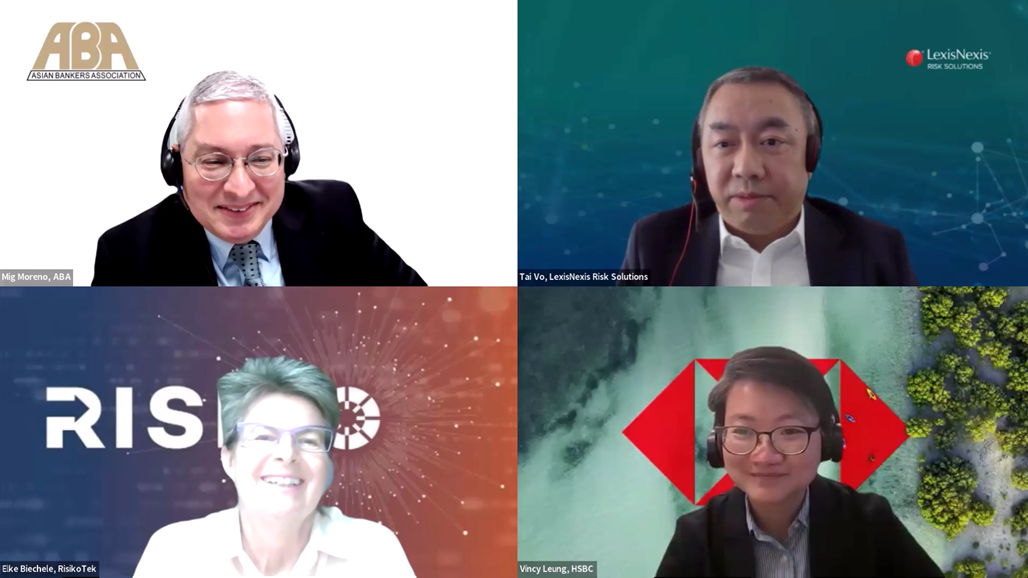
 The Asian Bankers Association (ABA) and LexisNexis Risk Solutions, an ABA Associate Member, held a successful webinar on “Global State of Fraud: Asia Perspective” on 12 February 2026 that gathered 420 registrants from 32 countries.
The webinar featured Thanh Tai Vo, Director of Marketing Planning at LexisNexis Risk Solutions. He was joined by Elke Biechele, CEO at RisikoTek, and Vincy Leung, Head of Fraud Analytics at HSBC during the panel discussion. The session was moderated by Mig Moreno, Deputy Secretary-Treasurer at ABA.
We present you hereunder the summaries of the presentation and panel discussion, as well as access to the video and the presentation file for ABA members only.
(1) Summary of Presentation
Tai Vo presented insights from the LexisNexis Risk Solutions Global State of Fraud and Identity Report, drawing on proprietary research and analysis of over 100 billion global transactions. He highlighted seven major fraud trends shaping the Asia-Pacific region and outlined how organizations can respond with a multi-layered defense strategy, including the following:
Escalation of First-Party Fraud
First-party fraud has doubled and now represents a significant share of fraud losses in APAC—up to 50% when related activities are included. Legitimate customers misuse their real identities through account bust-outs, refund abuse, promotional abuse, and mule activity. Economic pressures are contributing factors. Institutions must balance fraud controls with customer experience to avoid excessive friction.
Dark Web as a Fraud Marketplace
The dark web has become a mature fraud-as-a-service ecosystem, enabling account takeover and identity theft at scale. Businesses should counter this with deepfake detection, strong KYC, device fingerprinting, behavioral analytics, and intelligence sharing to stay ahead of organized crime.
Growth of Money Mule Networks
Organized mule networks launder billions annually and increasingly use crypto exchanges in APAC hubs. Case analysis showed how limited traffic monitoring uncovered extensive cross-border mule activity. Intelligence-sharing through API alerts allows banks to identify linked accounts faster and reduce losses.
Identity Verification Challenges
Organizations face difficulty onboarding emerging identities, reducing friction, and verifying age while protecting privacy. In APAC, synthetic identity risk and device/geolocation limitations are major concerns. Risk strategies must be tailored by industry and customer lifecycle.
Instant Payments and Cross-Border Risk
Faster payment systems increase fraud exposure, as criminals exploit rapid settlement. Effective mitigation requires assessing both sender and beneficiary risk, analyzing behavioral anomalies, device data, and payment patterns, and monitoring inbound as well as outbound flows.
The AI Arms Race
Generative AI is accelerating fraud sophistication, including deepfakes and AI-generated document forgery. Many APAC institutions now prioritize AI-driven detection models, sometimes combining multiple models to address complex fraud scenarios. Fraud prevention is increasingly an AI-versus-AI battle.
Data Collaboration and Consortia
APAC is leading in collaborative fraud prevention through banking consortia in Japan, Hong Kong, and Singapore, with expansion underway elsewhere. Shared intelligence enables earlier detection and stronger cross-industry risk visibility.
Tai Vo concluded that modern fraud requires a comprehensive, multi-layered approach combining digital intelligence, AI-driven analytics, cross-institution collaboration, and customer education. Fraud detection must be use-case specific rather than one-size-fits-all. Ultimately, coordinated action among financial institutions, businesses, regulators, and law enforcement is essential to counter increasingly organized and technology-enabled fraud networks.
(2) Panel Discussion Summary
Moderated by Mig Moreno, the panel discussion featured Thanh Tai Vo (LexisNexis Risk Solutions), Elke Biechele (RisikoTek), and Vincy Leung (HSBC). The session focused on the rapidly evolving fraud landscape in Asia and the strategic responses required from financial institutions.
The discussion began with the growing sophistication of fraud, particularly the industrialization of scam networks and the misuse of digital platforms. Thanh Tai Vo highlighted how fraud ecosystems are now highly organized and technology-enabled, using automation, social engineering, and cross-border mule networks to scale operations. He emphasized that financial institutions must adopt intelligence-led, data-driven strategies rather than rely on traditional reactive controls.
Elke Biechele stressed the importance of governance and risk culture. She noted that fraud prevention must be embedded at the board and senior management levels, with clear accountability and alignment between compliance, risk, and business functions. Institutions must balance fraud controls with customer experience, ensuring security measures do not create excessive friction. She also underscored the need for cross-border cooperation and regulatory collaboration to combat transnational fraud.
From a practitioner’s perspective, Vincy Leung shared how HSBC leverages advanced analytics and machine learning to detect suspicious behavior patterns. She highlighted the shift toward behavioral monitoring and real-time data analysis to identify mule accounts and emerging fraud typologies. Collaboration—both internally across departments and externally with industry peers—was described as critical to staying ahead of evolving threats.
The panel agreed that AI is both a risk and an opportunity. While fraudsters increasingly use AI to enhance scams, financial institutions can deploy AI-driven tools for anomaly detection, predictive modeling, and network analysis. However, human oversight remains essential to interpret complex cases and avoid overreliance on automation.
The discussion concluded with a consensus that combating fraud requires a multi-layered approach: advanced analytics, strong governance, cross-sector collaboration, and continuous adaptation. As fraud threats become more sophisticated and borderless, institutions must evolve from reactive defense to proactive, intelligence-based fraud risk management strategies.
The presentation file is available only to ABA members.
A recording of the webinar available at the ABA YouTube channel can be viewed below: