
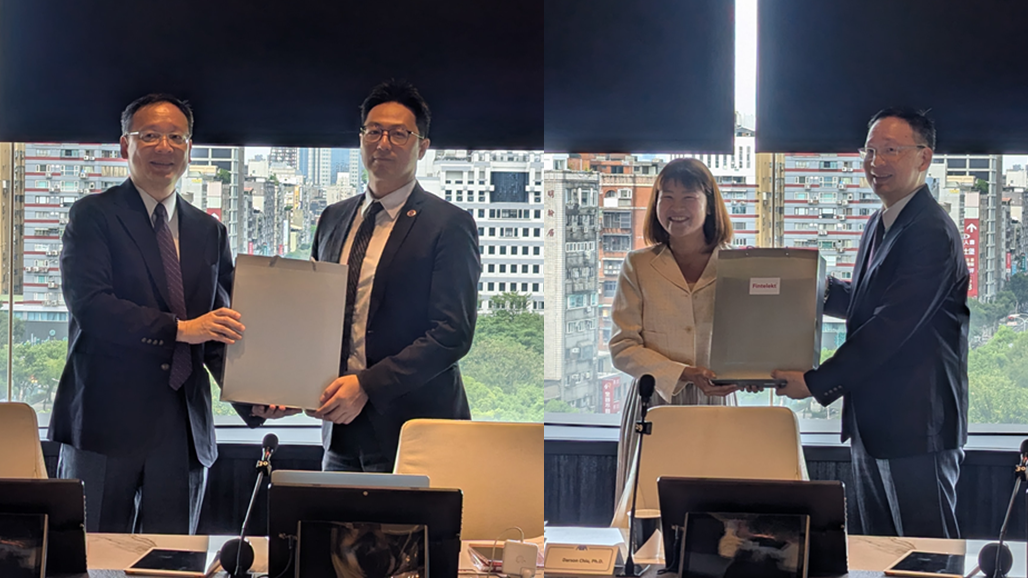
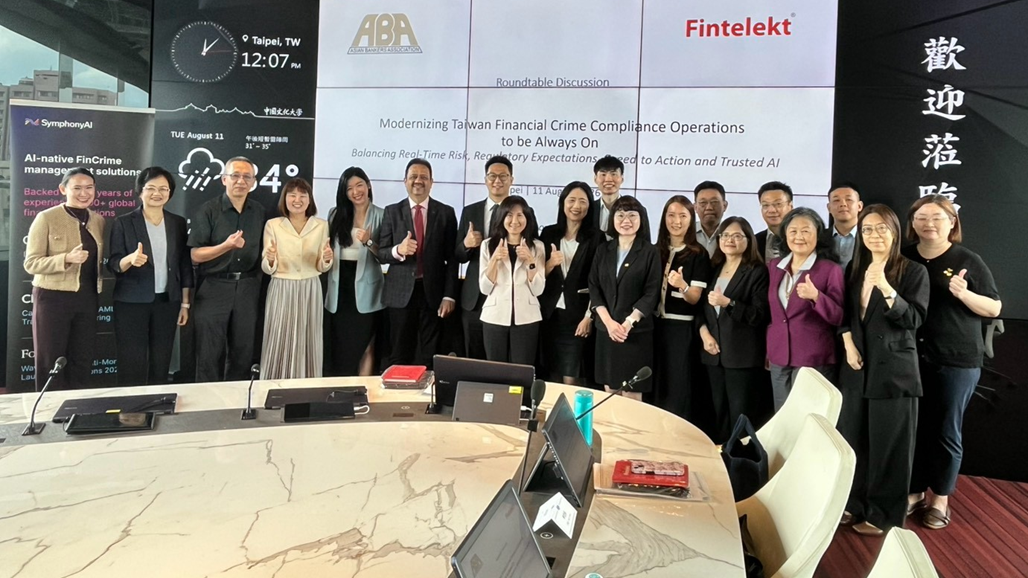
 The Asian Bankers Association (ABA), in cooperation with its Knowledge Partner Fintelekt Advisory Services and SymphonyAI, successfully concluded a high-level roundtable on Modernizing Taiwan Financial Crime Compliance Operations held on 11 August 2026 at the 10th Floor of Daxia Hall, Chinese Culture University’s Jianguo Campus in Taipei.
The event brought together senior anti-money laundering and compliance executives from 11 of Taiwan’s leading banks to exchange views on the rapidly changing financial-crime environment and the modernization of compliance operations. Discussions were candid, lively and highly interactive, creating a strong atmosphere of cooperation and a shared determination to strengthen Taiwan’s response to emerging AML and fraud risks.
Participating institutions included Bank of Taiwan, Cathay United Bank, Chang Hwa Bank, CTBC Bank, First Commercial Bank, Huanan Bank, Mega Bank, SinoPac Bank, TS Financial Holdings, Taiwan Cooperative Bank, and Land Bank. Most representatives were Chief Compliance Officers, Vice Presidents, or senior executives responsible for AML and financial-crime compliance, giving the roundtable a strong decision-making and operational perspective across Taiwan’s banking sector.
The programme opened with welcome remarks by Shirish Pathak, Managing Director of Fintelekt Advisory Services, who highlighted common financial-crime compliance challenges across jurisdictions and stressed the importance of information sharing among financial institutions and across national borders. He noted that regulatory thinking is increasingly moving beyond technical compliance toward measuring whether controls are genuinely effective.
Dr. Darson Chiu, Secretary Treasurer of the Asian Bankers Association, emphasized that technological advances are transforming both banking and financial crime, increasing the speed, reach and sophistication of illicit activity. He stressed that financial institutions must therefore combine faster detection and response with responsible use of technology, particularly trustworthy, accountable and properly governed artificial intelligence.
A principal keynote presentation was delivered by Wei-Yuan Lo, Executive Secretary of the Anti-Money Laundering Office of the Executive Yuan and Head Prosecutor at the Taiwan Shilin District Prosecutors Office, who examined recent money-laundering risk trends and emerging FATF priorities. Mr. Lo highlighted the global scale of fraud, the importance of strengthening the risk-based approach, and the growing need for information sharing across banking, telecommunications and technology sectors. He emphasized a shift from reactive responses toward proactive prevention and real-time disruption, supported by behavioural analytics and innovative technology.
Mr. Lo also drew attention to increasingly complex typologies, including mule accounts, structured routing, rapid fiat-to-crypto conversion, crypto cash-out patterns, abnormal remote banking logins and shared digital identities. He further stressed faster international asset recovery, stronger multilateral cooperation, closer coordination through anti-scam centres and more effective regulation of virtual-asset service providers.
Dr. Pei-Ling Tsai, former Executive Secretary of Taiwan’s Anti-Money Laundering Office and former Deputy General Manager of Taipei Fubon Bank, highlighted how financial crime in Taiwan has evolved from a predominantly external threat toward growing concern over insider-assisted misconduct. She described this as not only a compliance challenge but also an “integrity challenge,” stressing the importance of public trust and institutional credibility. She also noted that while AI cannot create integrity, it can help protect it by identifying unusual patterns and emerging risks.
The second half of the programme featured an intensive roundtable moderated by Shirish Pathak. Discussions focused on five broad themes: how financial crime in Taiwan has changed; whether criminal activity is outpacing existing controls; what will drive modernization of financial-crime compliance programmes; how trusted AI can support future operating models; and how banks should shape the next generation of compliance operations.
Participating bankers spoke openly about the fraud and AML typologies generating the greatest pressure, emerging threats over the next three to five years, operational challenges in detecting and reporting financial crime, and areas where future investment could have the greatest impact. The discussion reflected a broad recognition that faster payments, increasingly sophisticated fraud, cross-border transactions and evolving digital channels are placing greater pressure on traditional compliance models.
The programme concluded with Jordan Hoo, Senior AML Advisor at SymphonyAI, presenting the concept of “Always-on Compliance.” He outlined the transition from periodic risk assessments toward continuous risk alignment, supported by predictive, generative and agentic AI. The model is designed to identify changes in risk more rapidly while retaining human oversight, explainable outputs and continuous model validation.
The roundtable concluded on a highly positive note, demonstrating the value of bringing government officials, senior bankers, AML specialists and technology experts together for a candid exchange of practical experience. The principal conclusions and collective viewpoints emerging from the dialogue will now be consolidated into a White Paper, to be published in both English and Chinese in the coming weeks and shared with ABA member banks and relevant Taiwanese authorities.