
The Asian Bankers Association (ABA) and Temenos, an ABA Associate Member held a very deep and interesting panel discussion during the webinar on Financial Crime Mitigation and Agentic AI held on 21 April 2026.
The webinar, moderated by Irene Dravilla, Sr. Solution Marketing Manager at Temenos, and featuring Adam Gable, Sr. Product Directo at Temenos, and Peter Banham, Product Director at Temenos, examined how artificial intelligence (AI) is reshaping financial crime mitigation in a fast-evolving financial landscape.
A Rapidly Changing Landscape
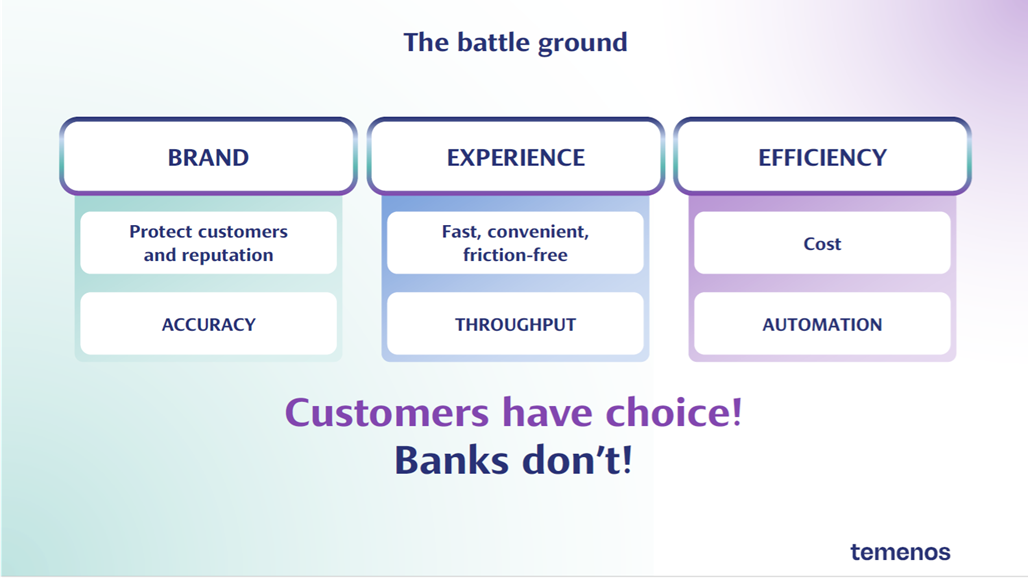
The global payments ecosystem—especially in the region of Asia-Pacific—is rapidly evolving, driven by real-time payments, QR systems, and cross-border flows. The growth increases transaction speed and customer expectations while heightening exposure to fraud and money laundering risks. At the same time, regulators are tightening oversight, and criminals are becoming more technologically advanced. These dynamics are making traditional compliance approaches insufficient. Financial crime mitigation is now a strategic priority, essential for protecting trust, reputation, and operational efficiency, particularly as compliance costs continue to rise.
The “Perfect Storm” for Compliance
Compliance teams face a “perfect storm” of rising transaction volumes, faster processing demands, frequent sanctions updates, and broader regulatory enforcement. Regulatory actions are now more widespread, targeting a larger number of institutions. Meanwhile, compliance costs—largely driven by human resources—continue to increase. Institutions must therefore process more data, faster and more accurately, while controlling costs. This growing complexity is pushing banks toward new operating models where automation and intelligent systems are essential.
AI as a Strategic Enabler
AI is emerging as a key response to these challenges, helping institutions improve efficiency, strengthen detection, and enhance analytics. By automating repetitive tasks and supporting decisions, AI allows compliance teams to manage higher volumes with greater accuracy. It includes both traditional machine learning and newer generative AI technologies, which expand use cases across monitoring, due diligence, and reporting. However, adoption remains cautious due to regulatory requirements, particularly around explainability and risk management.
Balancing Innovation with Regulation
Aligning AI adoption with regulatory expectations is critical. Regulators—especially in Asia-Pacific—support AI use but require transparency, explainability, and accountability. A phased approach is emerging: starting with AI operating in parallel (“listening mode”), progressing to advisory roles with human oversight, and eventually enabling selective automation in low-risk areas. This approach allows institutions to build trust in AI while maintaining control and compliance.
AI and the Evolving Threat Landscape
AI is also empowering criminals. Bad actors use it to create synthetic identities, automate fraud schemes, and simulate legitimate transaction behavior. This enables them to scale operations quickly and evade detection. As a result, financial crime becomes more asymmetric: criminals need only occasional success, while institutions must consistently prevent threats. This reinforces the need for advanced, proactive detection capabilities.
Improving Efficiency: Reducing False Positives
Reducing false positives is one of AI’s most immediate benefits. High false-positive rates increase costs and disrupt customer experience. AI can significantly improve detection precision, reducing unnecessary alerts while maintaining risk control. Reductions of up to 40–50% are achievable, allowing compliance teams to focus on genuine risks. However, institutions must carefully balance detection sensitivity with customer convenience.
Human Oversight and Accountability
Human oversight remains essential despite AI advances. Regulators require institutions to retain accountability, particularly for high-impact decisions. AI is best used to support detection, analysis, and operational tasks, while humans remain responsible for actions such as transaction blocking, onboarding decisions, and regulatory reporting. This “human-in-the-loop” approach ensures effective use of AI without compromising control.
Practical Adoption and System Modernization
A practical, targeted approach is key to AI adoption. Institutions should focus on specific use cases, ensure data readiness, and design for explainability from the outset. Rather than replacing systems, AI is typically integrated into existing AML and fraud frameworks to enhance performance. However, modernization is urgent, as legacy systems and fragmented data are no longer suitable for real-time, high-volume environments.
Insights from the Q&A Session
The Q&A reinforced that AI will not replace compliance teams but will enable them to scale by automating routine tasks and supporting decisions. Automation is appropriate for low-risk activities, such as closing clear false positives, but not for high-impact decisions like filing suspicious activity reports. In investigations, AI supports data gathering and analysis, while humans retain final judgment. The discussion also confirmed that AI enhances rather than replaces existing systems, and that financial crime will remain a dynamic, adversarial challenge.
Conclusion
Financial crime mitigation is shifting from reactive processes to proactive, intelligence-driven approaches. AI plays a central role by improving efficiency, strengthening risk management, and enhancing customer protection. However, success depends on combining AI with human expertise, strong governance, and regulatory alignment. Institutions that adopt a phased, targeted approach will be best positioned to manage evolving risks and stay ahead of increasingly sophisticated threats.
Key Takeaways
- AI is a strategic necessity for managing financial crime in a high-volume, high-risk environment.
- Compliance teams face a “perfect storm” requiring new operating models and technologies.
- Explainability and human oversight are critical to meet regulatory expectations.
- AI can significantly reduce false positives, improving efficiency and customer experience.
- Human-AI collaboration is essential to effectively combat evolving financial crime threats.
The presentation PDF is available to ABA members only.
A video recording of the webinar can be viewed at the ABA YouTube.