
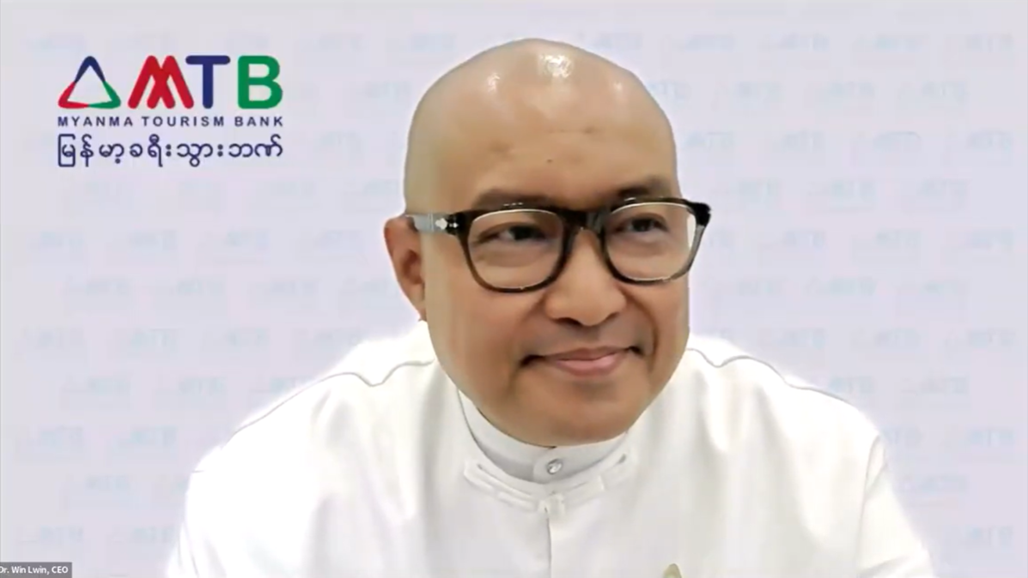
The Asian Bankers Association (ABA) and Myanma Tourism Bank, a member of the ABA, held a very candid webinar on Myanmar’s Banking Sector: Transformation, Opportunities and International Partnerships on 30 July 2026 at 14:00 Singapore time.
Hereunder is a summary of the presentation:
(1) Introduction
Mr. Mig Moreno, ABA Deputy Secretary-Treasurer, introduced MTB as a new ABA member and a private commercial bank serving retail, SME, corporate, trade finance and tourism-related customers through 19 branches.
He also introduced the featured speaker, Dr. Win Lwin, CEO of MTB and ABA Board Member, highlighting his more than 30 years of international banking experience.
(2) Presentation by Dr. Win Lwin, CEO, Myanma Tourism Bank
Dr. Win Lwin presented a balanced assessment of Myanmar’s banking sector, acknowledging its macroeconomic and operational challenges while emphasizing its long-term structural opportunities.
Myanmar has remained one of ASEAN’s least-penetrated banking markets, with low formal financial intermediation, growing digital connectivity and significant development needs. Institutions adopting a patient and disciplined approach could be well positioned as conditions improved.
MTB did not seek to become Myanmar’s largest bank, but rather as a focused, agile and well-governed institution. Since Dr. Lwin became CEO in May 2023, the Bank had concentrated on strengthening governance, risk management, operational discipline and institutional culture before accelerating growth. It subsequently expanded its digital capabilities through MTB Pay, mobile banking and simplified customer services.
Governance has remained central to MTB’s transformation. The bank hasreinforced board oversight, risk and compliance committees, internal audit and the three-lines-of-defence model. It has also strengthened AML/CFT controls, sanctions screening, customer due diligence and transaction monitoring. Dr. Lwin stressed that risks should be identified, controlled, monitored and communicated transparently.
MTB operates 19 branches, employs more than 500 staff and served over 100,000 banking customers. Its MTB Pay ecosystem has grown to more than 300,000 users. Although tourism remains part of its identity, MTB also serves retail customers, SMEs, corporate clients and trade finance businesses. Its correspondent banking and remittance partnerships has already connected it with the regional financial system.
Myanmar’s population of approximately 55 million, relatively young demographic profile and low level of financial inclusion created potential demand for banking, SME finance and digital services. Mobile connectivity could help institutions reach underserved customers more quickly than traditional branch expansion. However, inflation and economic uncertainty requires disciplined liquidity management and prudent lending.
Dr. Lwin reported that MTB has assets of approximately MMK915 billion, deposits of MMK685 billion and loans of around MMK385 billion. Its loan-to-deposit ratio stands at approximately 56 percent, while its capital adequacy ratio of 9.3 percent remains above the regulatory minimum.The bank has a non-performing loan ratio of 3.84 percent and a liquidity ratio of approximately 46.31 percent.
Digital payments and remittances represent important growth opportunities. MTB Pay has brought many first-time users into formal digital finance, while remittance services support Myanmar workers and their families overseas. Dr. Lwin estimated that more than 10 million Myanmar citizens live or worke abroad. He also highlighted Myanmar’s MMQR platform as a foundation for domestic interoperability and future ASEAN payment integration.
Trade finance remains another strategic priority. Myanmar businesses require assistance with imports, exports, letters of credit, working capital, foreign exchange and settlement services.
Dr. Lwin identified five main areas for international cooperation: correspondent banking, trade finance, SME lending, digital payments and remittances, and sustainable finance.
He emphasized that MTB is not seeking immediate large-scale commitments. Partnerships should begin with carefully structured initiatives, followed by technical discussions, due diligence and gradual expansion. MTB’s ambition is to become a trusted, resilient and technology-enabled banking partner supporting Myanmar’s long-term development.
(3) Q&A Session
During the Q&A session which was moderated by Mr. Moreno. Dr.Lwin in response to questions about Myanmar’s FATF status and compliance costs said governance and compliance are essential investments. MTB hasimplemented sanctions-screening software, transaction-monitoring systems and other controls, and he believes the related costs remains manageable.
Asked what distinguished MTB from other private banks, he cited its transformation since 2023, growing digital and API capabilities, regional correspondent and remittance relationships, and risk-control framework. MTB does not claim to be the largest bank, but aims to be among the most transparent and partnership-ready institutions.
On ASEAN banking integration, Dr. Lwin envisions greater payment interoperability, more efficient trade settlements and stronger correspondent banking relationships. Myanmar’s MMQR system could serve as a domestic foundation, while future cross-border integration would require regulatory and technical coordination among ASEAN central banks.
The discussion also covered overseas workers, remittances and AML/CFT controls. Dr. Lwin estimates that at least 10 million Myanmar citizens lived abroad, although precise figures remained difficult to confirm. Informal remittance channels remains a challenge, while MTB has strengthened KYC, electronic KYC, sanctions screening and transaction monitoring.
Finally, Dr. Lwin said MTB seeks to balance profitability with financial inclusion by treating digital services and SME lending as both commercial and developmental opportunities. He also reaffirmed the bank’s commitment to supporting Myanmar’s tourism industry and invited international institutions to explore responsible and mutually beneficial partnerships.
A copy of the presentation file is available to ABA members only.
The video recording of the session is available at the ABA YouTube channel.