
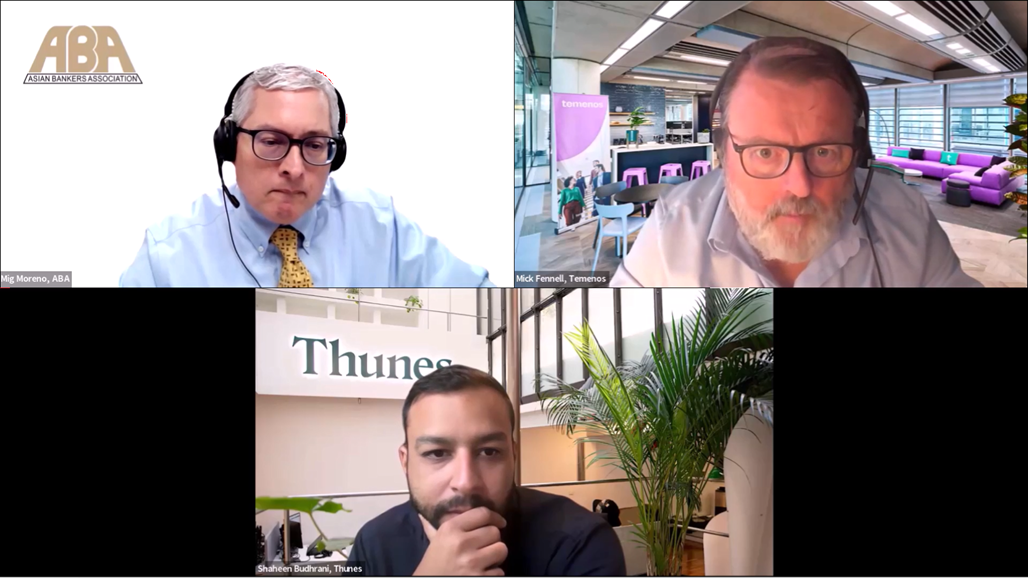
The Asian Bankers Association (ABA), in cooperation with Temenos and its partner Thunes, held a very successful webinar “Beyond Traditional Payments: Tokenization, AI & Path to Scale” on 24 September 2026, attracting 281 registrants from 21 countries.
The webinar aimed to examine how banks can strengthen customer differentiation, operational efficiency and resilience as payments continue to evolve.
(1) Opening Remarks by Mig Moreno, Deputy Secretary, ABA.
Opening the session, Mig Moreno noted that the payments landscape is changing rapidly as artificial intelligence, tokenization and new approaches to scaling reshape financial services.
He introduced Mick Fennell, Director of Payments at Temenos, who would address the technological and infrastructure changes affecting payments, and Shaheen Budhrani, Global Head of Strategic Partnerships at Thunes, who would focus on cross-border payments, interoperability and scaling.
(2) Presentation by Mick Fennell, Director of Payments, Temenos
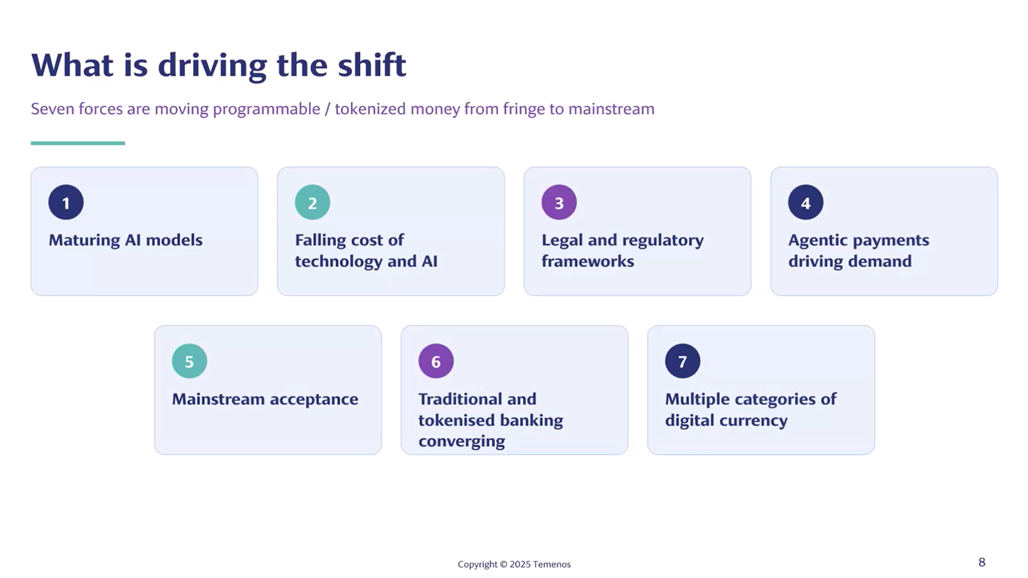
Mick Fennell outlined how tokenized money and artificial intelligence are beginning to reshape payment infrastructure. He noted that the industry is already under pressure from rising transaction volumes, 24/7 customer expectations, greater competition and the growing number of payment endpoints. Over the past decade, modernization has been driven by ISO 20022, instant payments, cloud architectures, open banking, APIs and digital wallets. The next major drivers, however, are increasingly tokenization and AI.
Fennell described tokenized money as a digital representation of traditional currency or bank deposits issued on blockchain or distributed-ledger technology. Its advantages include programmable money, automation, embedded compliance, instant settlement, greater transparency and lower settlement risk. However, tokenized payments are not necessarily cheaper today because limited liquidity and conversion between fiat and digital currencies can create additional fees. He described the current stage as “Tokenization 3.0,” in which stablecoins, tokenized deposits and central bank digital currencies are moving toward mainstream financial use, supported by lower technology costs and clearer regulatory frameworks.
He identified four main categories of digital money: CBDCs, privately issued stablecoins, tokenized bank deposits and decentralized cryptocurrencies. Each carries different implications for trust, legal claims, liquidity, redemption, compliance and operational resilience. Banks therefore need structured assessment frameworks to determine which forms of digital money they will support. Fennell stressed that financial institutions will continue to act as trusted gatekeepers, with customers expecting them to conduct proper due diligence before providing access to new financial instruments.
Looking ahead, Fennell argued that traditional and tokenized finance will increasingly operate together. Banks will need platforms capable of managing tokenized assets while connecting to multiple networks, stablecoins and APIs. AI will also become embedded throughout payment processing, particularly in fraud detection, automated payment repair, smart routing and liquidity management. He concluded that AI and tokenization are complementary technologies: as commerce becomes more automated and machine-driven, payment systems must be capable of moving money at comparable speed.
(3) Presentation by Shaheen Budhrani, Global Head of Strategic Partnerships, Thunes
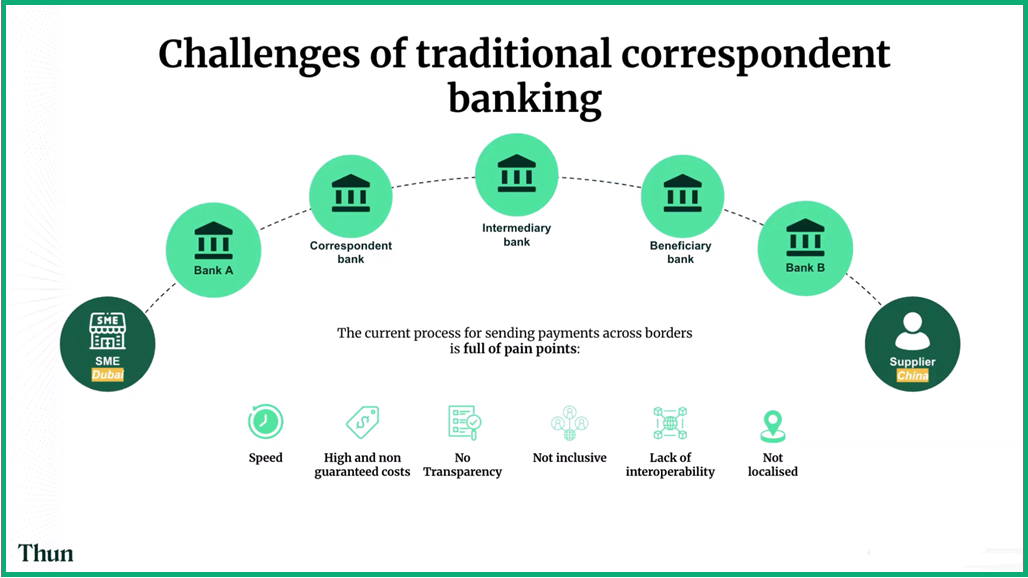
Shaheen Budhrani focused on the challenge of scaling global payment operations. He explained that scale involves more than transaction volume; banks must simultaneously expand operational capacity, compliance, network connectivity and customer offerings. This can be difficult because retail, SME and transaction banking often have different requirements, creating internal bottlenecks. Thunes therefore approaches scaling from the perspective of customer needs and the value that payment infrastructure can deliver.
Budhrani highlighted the limitations of traditional correspondent banking, including slow transfers, uncertain costs, limited transparency and weak interoperability with newer financial ecosystems. These weaknesses are increasingly important as consumers expect the same speed and convenience from banking that they receive from digital commerce. He emphasized the growing importance of mobile wallets, particularly in emerging markets where wallet penetration can significantly exceed conventional banking penetration. As a result, modern payment systems must connect bank accounts, wallets, cards, stablecoin platforms and other endpoints.
The central challenge, he argued, is interoperability and effective last-mile delivery. Banks need scalable platforms that can route payments across different networks without creating excessive operational complexity. Treasury and compliance are essential foundations: deep liquidity pools support instant payments and transparent foreign-exchange pricing, while robust compliance systems are needed to address sanctions, travel rules and local regulatory requirements. Scaling payments therefore requires the combined development of technology, liquidity, connectivity and compliance.
(4) Q&A Session
The Q&A session focused on modernization priorities, risk, regulation, AI and the barriers to scaling. Fennell identified infrastructure scalability, resilience and integration as the most important priorities. Banks need systems capable not only of handling higher transaction volumes but also of connecting with multiple providers and supporting different forms of money. Budhrani added that competitive pressure from fintechs, digital banks and mobile-money operators means banks must reassess where customers are transacting and whether their payment strategies remain relevant. Fennell also stressed that fintechs should not only be viewed as competitors but as potential partners within broader financial ecosystems.
Risk was another major concern. Fennell warned that stablecoins and other digital currencies can fragment liquidity, creating funding challenges, while banks must carefully assess which instruments they are willing to support. Budhrani highlighted fraud and cybersecurity, particularly as AI agents become more involved in transactions. Both speakers emphasized that faster payments can also accelerate fraud, requiring stronger controls, continuous monitoring and greater use of AI to detect suspicious activity and reduce false positives.
On geopolitical and regulatory uncertainty, the speakers stressed flexibility and resilience. Budhrani argued that banks should maintain adaptable market connectivity and remain open to new technologies, while Fennell emphasized configurable, rules-based platforms that allow institutions to adjust risk parameters and respond quickly to regulatory changes. They also viewed SWIFT's development of blockchain-based infrastructure positively, particularly because global standards could help reduce fragmentation and lower the cost of tokenized payments. Regulators, meanwhile, were described as essential gatekeepers, although their approaches differ widely across jurisdictions.
The final discussion focused on practical AI applications and barriers to growth. Fennell identified fraud detection, sanction-screening optimization, automated payment repair, intelligent routing and AI-enabled operational tools, while Budhrani highlighted transaction monitoring and treasury forecasting. The principal bottlenecks were identified as legacy infrastructure, regulation, fraud risk and resistance to change. Both speakers ultimately agreed that the largest obstacle may be human rather than technological: banks that fail to adapt risk losing competitiveness as traditional and tokenized finance increasingly converge.
A copy of the presentation filea are available to ABA members only.
A recording of the webinar is available at the ABA YouTube channel.