
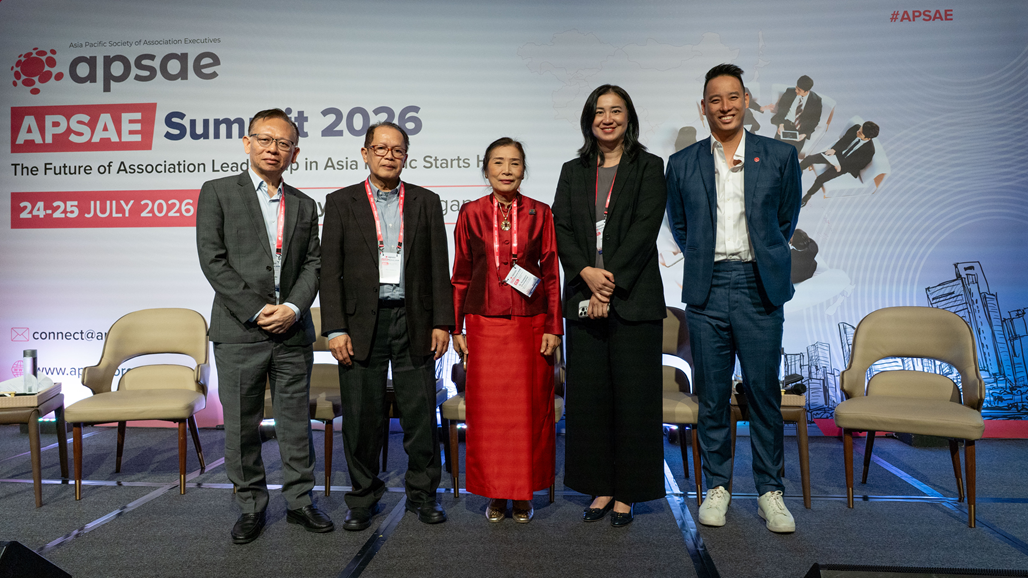
 Deputy Secretary Mr. Amador Honrado Jr. represented the Asian Bankers Association (ABA) at the Asia Pacific Society of Association Executives (APSAE) Summit 2026 held on 24-25 July 2026 at the Marina Sands in Singapore.
Tthe APSAE Summit 2026 marked the launch of the Society and brought together senior association leaders, partners, and ecosystem stakeholders from across Asia Pacific. The Asia Pacific Society of Association Executives (APSAE) is a neutral, non-profit platform connecting association leaders, partners, and knowledge institutions across the region. APSAE membership is designed for association leaders across the Asia-Pacific region who want regionally relevant insights, trusted peer exchange, and long-term professional connection.
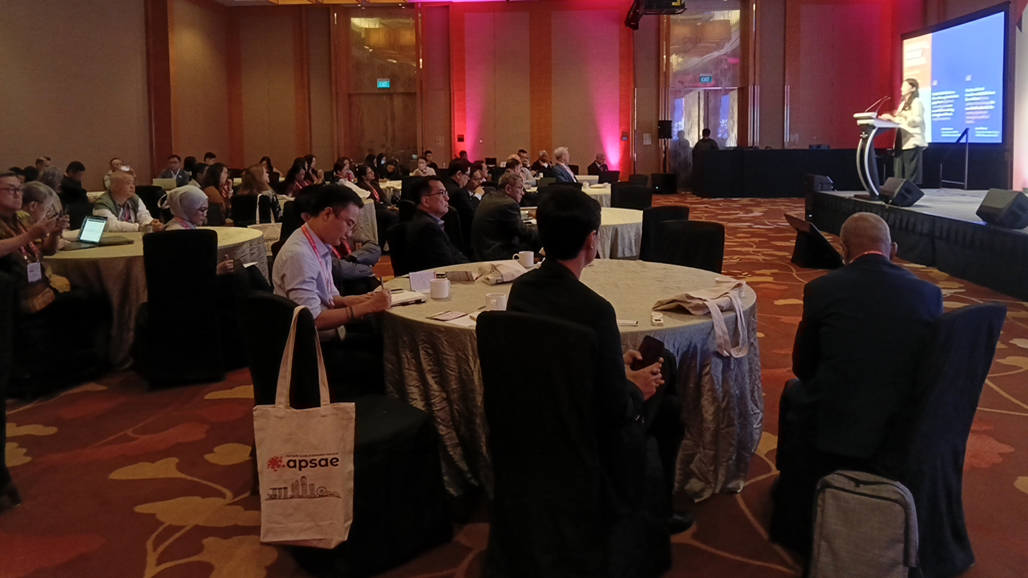
The landmark gathering hosted some 100 association CEOs, Executive Directors, and emerging leaders from more than 10 countries for executive masterclasses, peer-to-peer collaboration, and knowledge sharing. It served as the inaugural event for APSAE and welcomed the organization’s first generation of founding members, including the ABA and CACCI.
The 1.5-day conference agenda was designed for leaders, executives, and members of professional associations, trade bodies, registered societies, and non-profit organizations in Asia Pacific region. It addressed key transformational factors such as regulatory changes, digital adoption, shifting funding landscapes, governance reforms, membership engagement challenges, and the need for innovation ever changing world order.
The focus areas of discussion included member engagement, governance, financial sustainability, AI, and the future of leadership across the Asia-Pacific. The event also featured a strategic Knowledge Partnership with the Brussels-based Union of International Associations (UIA), further strengthening global-to-regional civil society ties.
Participation in Panel Discussion
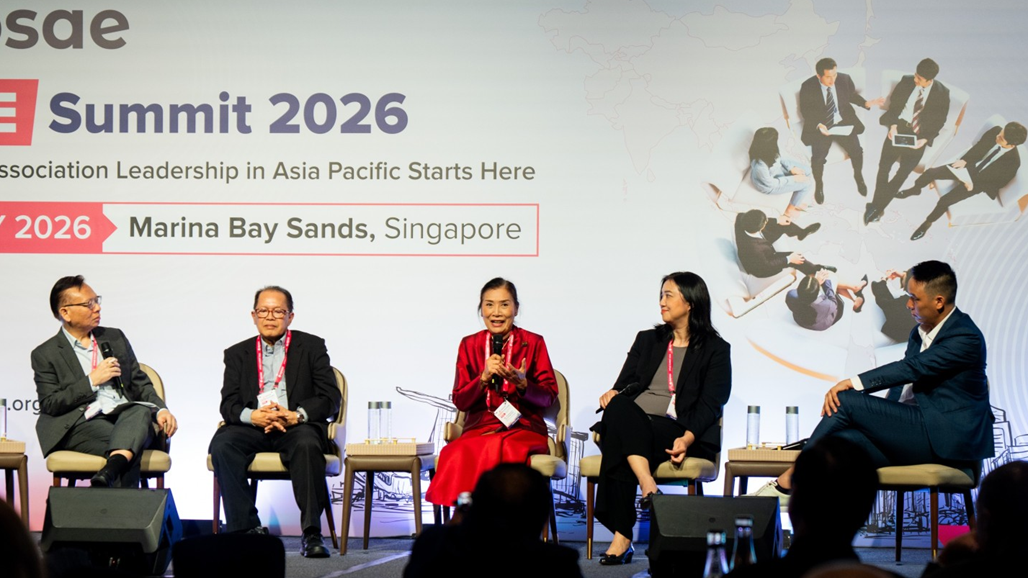
ABA Deputy Secretary Mr. Honrado was a panelist during the Panel Sessions 2, which focused on the topic “Beyond dues –Monetising data, Partnerships & Non-Due revenues.”
The session noted that currency volatility, regulatory shifts, and funding cuts are destabilising association budgets across APAC. The panelists exchanged views on the need to move beyond traditional dues to explore ethical, practical revenue models—sponsored digital learning, market intelligence reports, tiered corporate memberships, and government partnerships. Learn to leverage anonymised, consent-based member data for sponsor insights without eroding trust. They cited the importance of walking away with an action plan tailored to small, medium, and large associations—launching at least one new, sustainable revenue stream post-conference.
For his part, Mr. Honrado elaborated on some of the proposals that ABA is considering as possible sources of additional revenue other than the membership fee to augment its financial resources and enable the Association to provide additional services to its members. He highlighted the following:
(1) Possible sharing of the registration fees and sponsorship receipts collected by the host organization from the holding of the Annul General Meeting and Conference - However, he pointed out that based on past years’ experience, the host organizations may not be in a position to agree to the said sharing arrangement since receipts normally fall short of expenses due to a high cost of organizing the event. Hence, the ABA has recently proposed an Annual Conference Sponsorship Program under which it will invite an organization to sponsor an amount that will be used exclusively for inviting renown speakers and thought leaders to be Keynote Speakers for the Conference. The ABA believes that the presence of the renown Keynote speakers will help attract participation from members and other guests, and help build up the image of ABA Conferences in the global stage. In exchange for its subsidy, the sponsor will be acknowledged as a strong supporter of the Conference and be prominently featured in the promotional materials of the event as well as in the ABA website and the ABA Newsletter.
(2) Sharing of participation fees collected by ABA Knowledge Partners from training programs they jointly organize with the ABA for members and its network on topics of current interest to them – In addition to fee sharing, the ABA would also request Knowledge Partners to provide discount off the participation fee for ABA members, as well as a number of complimentary seats.
(3) Collecting fees from organizations who may be interested to post advertisements in the monthly ABA Newsletter and its other publications – Mr. Honrado pointed our that this proposal has not been implemented so far. Instead, what the ABA has done is to invite the interested organization to consider ABA membership which will then provide them the benefit of submitting articles to the monthly ABA Newsletter about any new product, service, or event that that would like to promote to ABA members and other readers of the Newsletter.
Other Summit Topics
The other topics covered by various speakers and panelists during the Summit included the following:
- Why Associations Matter Now More than Ever
- The World Has Moved On… Has your Association?
- Power of Advocacy
- Panel Session 1: Beyond Borders & Screens: Reimagining Member Loyalty in APAC’s Hybrid Reality
- Better Standards for Better Trade, Better Trade for a Better World
- Panel Session 3: Building Volunteer Pipelines When Everyone is Overstretched
- Panel Session 4: Leveraging Ecosystem to Deliver Impact Amid Uncertainty
- Panel Session 5: From AI Hype to Everyday Workflows
- Special Session: The Importance of Hope
- Mainstreaming Sustainability and Resilience in Association Management
- Building an AI-Ready Association Culture
Discussion Highlights
Highlights of the discussions among the speakers, panelists, and other participants included the following:
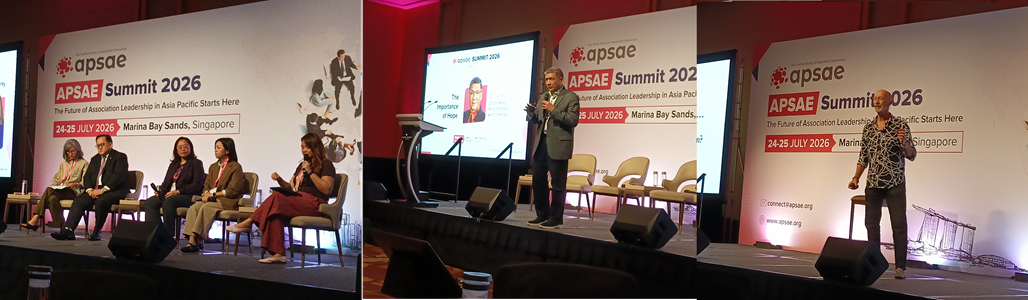
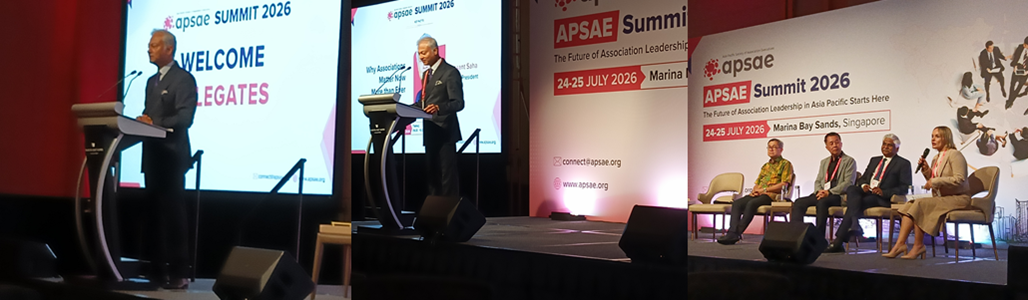
(1) APSAE President Mr Prasant Saha challenged the delegates to rethink the role of associations in a rapidly evolving Asia Pacific, putting forth the message that the future belongs to organisations that unite industries, transcend borders and become trusted platforms for collaboration.
(2) The delegates were challenged with a simple yet profound question: "The world has moved on... has your association?" That question is far bigger than organisational strategy. It is ultimately a question about leadership. Because organisations rarely resist change. People do. The leadership is the courage to move before certainty arrives. The participants were reminded that the associations that thrive tomorrow will be those willing to rethink long-held assumptions today.
(3) Discussions also reinforced another fundamental truth. That advocacy is not simply influencing policy. It is earning trust. It is giving industries a collective voice. It is transforming expertise into meaningful societal impact. When associations advocate effectively, they do not merely represent members. They strengthen economies, improve industries and ultimately improve lives.
(4) Throughout the panel discussions, one powerful message kept resurfacing. Whether we were discussing member engagement, volunteer leadership, new revenue models, event ecosystems or artificial intelligence. The conversations were never truly about technology, finance, or governance. They were about people. How do we create stronger communities?
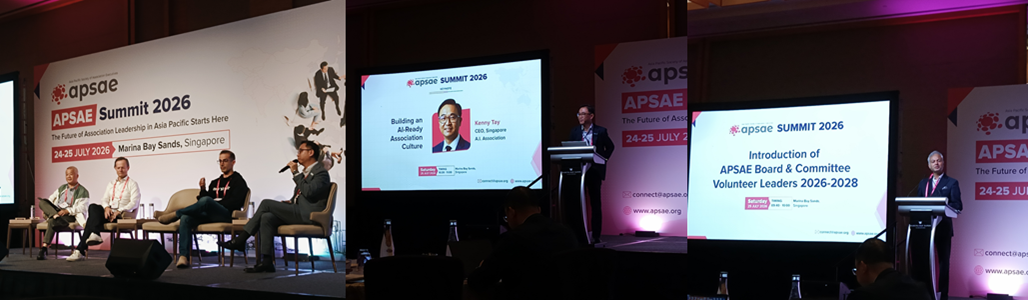
(5) How do we inspire participation? How do we build trust? How do we create organisations that people genuinely want to belong to? Technology may change. Business models may evolve. But people remain at the heart of every successful association. Discussions in one session explored loyalty beyond borders and beyond screens. It reminded delegates that in today's hybrid world, members no longer compare us only with other associations. They compare every experience with the very best experience available anywhere. Relevance is no longer optional. It has become the associations’ licence to lead.
(6) Another conversation challenged delegates to rethink sustainability. Membership dues alone are no longer enough. Associations must diversify intelligently, embrace ethical partnerships, unlock the value of knowledge, data and education, while preserving the trust that defines our purpose. Sustainability is not simply about financial resilience. It is about ensuring our missions continue long after today's leaders have moved on.
(7) Delegates also explored the future of volunteerism. Perhaps one of the sessions’ most inspiring reminders was that volunteers are not disappearing. Purpose still attracts people. Meaning still inspires commitment. The challenge is not finding people willing to contribute. The challenge is creating organisations worthy of their time.
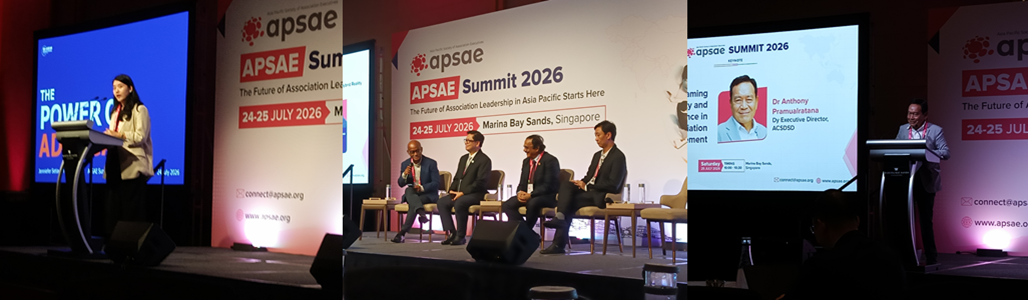
(8) Discussions on standards and international trade reminded the participants that associations are often the invisible infrastructure behind global progress. When standards improve, industries become stronger. When industries become stronger, trade expands. When trade expands, societies prosper. The work of associations may often happen quietly. But its impact echoes across economies.
(9) The session on AI captured one of the defining questions of todays’ generation. Artificial intelligence will undoubtedly transform how we work. But the session’s conversation nudged delegates to something equally important. Technology should never replace trust. It should strengthen it. AI may process information but Only people create relationships. Only leaders inspire confidence. Only communities create belonging.
(10) The final panel discussion addressed the importance of Hope. That Hope is not optimism or action. Hope is the decision to keep building despite uncertainty. Hope is choosing collaboration over isolation. Hope is believing that together members can shape a better future than the one they inherited.
(11) The Summitt concluded that perhaps that is exactly what APSAE represents. Not simply another conference. But hope. Hope that associations across Asia Pacific can learn from one another. Hope that collaboration will replace fragmentation and competition. Hope that together, APSAE members can build stronger professions, stronger industries, stronger communities, and ultimately a stronger Asia Pacific—one whose contributions continue to earn the admiration, trust and respect of the world.
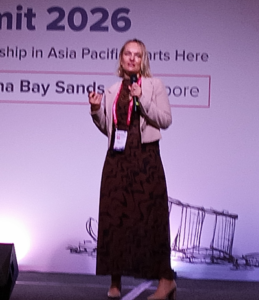 Masterclass: The Art of Making Members Come to You
The Summit also included a 1.5 hour Masterclass on “The Art of Making Members Come to You” which was conducted by Ms. Olena Lima, Founder of Member Boat, a marketing agency in new South Wales, Australia.
An important point cited by Ms. Lima during the session was the importance of building the Association that its future members need. She said that thriving as an Association is about relevance, representation, diversity, and resilience. “It is what makes a community thriving, vibrant and alive, asking whether the membership model, community experience, and business processes still match the market the association now serves.”
Ms. Lima pointed out that some of the challenges faced by the Association in its efforts to thrive include the following: (a) Membership models and business processes are outdated; (b) The membership is ageing with a thin pipeline of younger professionals; (c) The Association could benefit from being more diverse and inclusive; and (d) The difficulty of staying relevant in a fastchanging industry.
She said that embarking on a membership marketing framework involve five stages. Understand, Nurture, Grow, Optimize, and Thrive. Each one breaks down the activities, tools and outcomes that move an association forward:
- Understand: Turn member insights into better decisions
- Nurture: Create the member experience that gives people a reason to stay
- Grow: Building relationships with prospective members
- Optimize: Optimizing your team performance
- Thrive: Build the association your future members need
Ms. Lima observed that the Association can improve the situation by: (a) Adjusting membership models and business processes to match current market trends; (b)Developing practical diversity, equity and inclusion initiatives that improve representation, access, participation, and leadership pathways across the membership; (c) Building pathways that attract and develop younger professions early in their careers; (d) Revisiting the Association’s story regularly, so it keeps pace with the profession it serves; and (e) Testing new membership offers, participation models, and volunteering pathways that reflect how younger and emerging professionals want to engage.
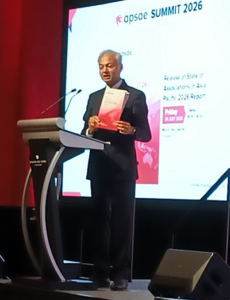 Launch of the State of Associations in Asia Pacific 2026 Report
The Summit also served as an occasion for APSAE to launch the “State of Associations in Asia Pacific 2026 Report”. The Report is the first comprehensive assessment of the industry and professional associations across the region. It reveals that associations face unprecedented challenges – geopolitical uncertainty, digital disruption, funding pressures, governance gaps, and talent shortages – but also immense opportunities to shape the future of global collaboration and sectoral advancement.
The Report puts forward a 10-point policy roadmap for governments, regional bodies, industry leaders, and association executives across Asia-pacific region. Key recommendations include formally recognizing associations as strategic economic enablers, establishing APSAE as the regional authority, incentivising MICE-led growth, enabling revenue diversification, accelerating digital and AI transformation, strengthening governance frameworks, building a regional talent pipeline, promoting globalization, expanding Mutual Recognition Arrangements (MRAs) and establishing a regional data infrastructure.
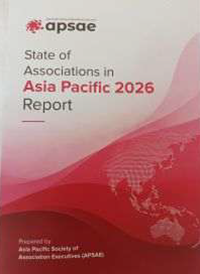 The Report’s central thesis is that associations are not just industry bodies – they are strategic regional assets. Empowering them is a prerequisite for sustainable growth, innovation, and global leadership across the Asia Pacific.
In his Foreword for the Report, APSAE President Mr. Prasant Saha pointed out that “As Pacific continues to drive global growth, we must empower associations to:
- Drive policy dialogue that is evidenced-based and forward looking
- Facilitate international partnerships for trade, investment, and knowledge transfer
- Strengthen the region’s position as a global MICE and knowledge destination
The Report also quoted a statement by ABA Deputy Secretary Mr. Amador Honrado on the importance of associations, in which he noted that “Associations in the Asia-Pacific region can amplify their collective impact by recognizing the importance of networking to encourage greater interaction among their members, by maintaining closer relationship with other international organizations not only in Asia Pacific but outside the region as well.”