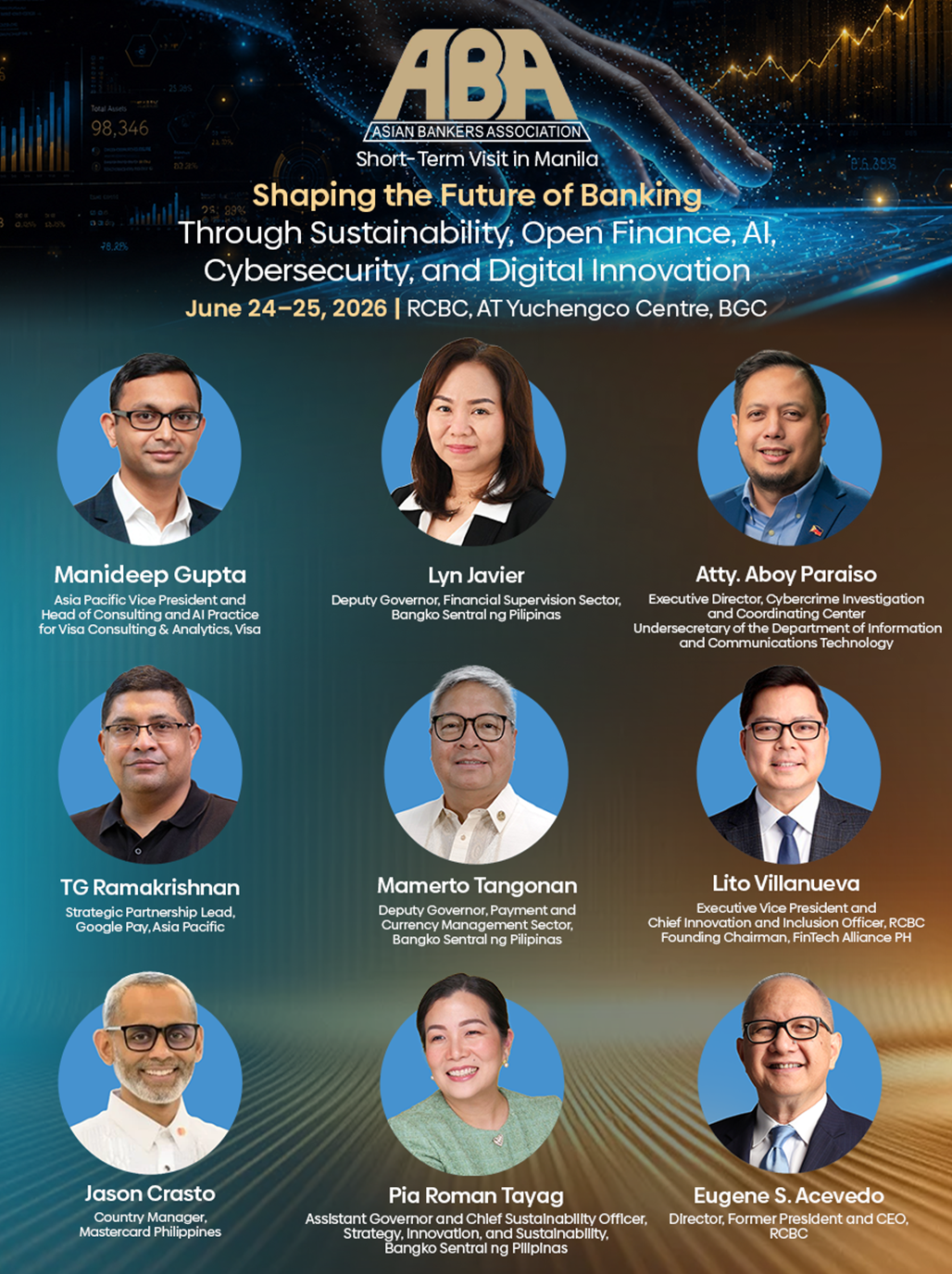


The Asian Bankers Association (ABA), in collaboration with Rizal Commercial Banking Corporation (RCBC), is inviting ABA members and friends to the Short-Term Visiting Program to be held on June 24–25, 2026 in Manila, Philippines.
This 1.5-day program will bring together industry leaders and practitioners to exchange insights on key developments shaping the banking landscape, with a focus on digital innovation, financial inclusion, and emerging technologies. Topics are expected to cover areas such as digital banking platforms, open finance, payments innovation, and new frontiers including AI and stablecoin applications.
The program will feature a mix of expert-led sessions and interactive discussions, providing participants with practical perspectives and opportunities for knowledge exchange.
AGENDA
Day 1: June 24, 2026
09:00 Opening Remarks by ABA Representative
09:30 Module 1: Sustainability in Banking: From ESG Compliance to Value Creation and Competitive Advantage
Speaker: Pia Roman Tayag, Assistant Governor and Chief Sustainability Officer, Strategy, Innovation, and Sustainability Office, Bangko Sentral ng Pilipinas
Sustainability in banking isn’t just about compliance or ESG reports anymore. It’s about how banks create long-term value. As climate risk, inequality, and rising governance expectations reshape markets, banks need to move from passive financiers to active enablers of sustainable growth.
This conversation looks at how sustainability becomes part of the core strategy. That means scaling green finance, building inclusive digital ecosystems, integrating climate risk into decision-making, and pushing responsible innovation. It also raises a tougher question. Can sustainability drive new revenue, deepen customer trust, and strengthen the balance sheet over time?
Areas worth exploring:
- Shifting ESG from a reporting requirement into a real revenue driver
- Financing the transition through green, blue, and transition finance, especially in emerging markets
- Embedding climate risk into credit, capital allocation, and portfolio strategy
- Using digital banking to expand inclusion and support sustainable outcomes
- Leveraging AI and data to measure impact and scale it effectively
10:30 Coffee Break
11:00 Module 2: Open Finance Platform Banking: Unlocking the PERA Initiative as a National Wealth Infrastructure
Speaker: Jose Recon Tano, Director and Head BSP PERA Technical Working Group, Bangko Sentral ng Pilipinas
The Personal Equity and Retirement Account (PERA) has long been positioned as a tax-advantaged retirement vehicle, yet its transformative potential remains significantly underutilized. In the era of Open Finance, embedded banking, and digital ecosystems, PERA can evolve far beyond a standalone investment product into a fully integrated, digital-first wealth infrastructure.
This topic reframes PERA not merely as a compliance-driven savings instrument, but as a scalable, API-enabled platform capable of democratizing long-term investing and retirement readiness for every Filipino.
It explores how banks, fintechs, regulators, employers, and ecosystem players can converge to transform PERA into a frictionless, interoperable, and intelligent financial layer seamlessly embedded into everyday digital banking journeys.
At its core, the discussion highlights how technology, behavioral finance, and ecosystem collaboration can unlock PERA’s next phase of growth making wealth accumulation more accessible, personalized, and inclusive at scale.
Key areas to explore:
- From product to platform: repositioning PERA within the Open Finance and embedded banking architecture
- API-driven distribution: embedding PERA capabilities across digital banking apps, e-wallets, super apps, employer platforms, and digital marketplaces
- Democratizing wealth creation: making retirement investing intuitive, affordable, and accessible for underserved and mass-market Filipinos
- Interoperability and portability: enabling seamless onboarding, contribution, transfer, and withdrawal experiences across institutions
- Public-private collaboration: aligning regulators, financial institutions, fintechs, employers, and government stakeholders toward a unified retirement ecosystem
- Financial inclusion at scale: positioning PERA as a foundational layer for long-term financial resilience, economic empowerment, and inclusive nation-building
12:00 Lunch
13:00 Module 3: Cybersecurity by Design: Operationalizing the NASH Initiative as the Philippines’ Digital Trust Backbone
Speaker: Atty. Aboy Paraiso, Executive Director, Cybercrime Investigation and Coordinating Center and Undersecretary of the Department of Information and Communications Technology
The Cybercrime Investigation and Coordinating Center is driving a shift from reactive enforcement to proactive defense through the NASH (National Anti-Scam Hub) initiative. In a landscape where digital fraud evolves faster than regulation, cybersecurity has to be built in from the start, not bolted on later.
This frames NASH as more than a coordination hub. It becomes a real-time, intelligence-driven backbone for preventing, detecting, and responding to fraud. It also makes cybersecurity a shared responsibility across government, banks, fintechs, and telcos, grounded in data sharing, interoperability, and fast, coordinated action.
Areas to explore:
- Embedding cybersecurity at the architecture level across financial ecosystems, moving from reactive to predictive
- Positioning NASH as core infrastructure, enabling real-time threat intelligence, account freezing, and coordinated response
- Scaling interoperability by linking banks, e-wallets, telcos, and law enforcement through secure APIs
- Strengthening trust as a competitive advantage, with visible and system-wide protection for consumers
- Balancing fast data sharing with strong governance and privacy safeguards under Philippine law
- Deepening industry collaboration through institutionalized public-private partnerships against cybercrime
14:00 Module 4: Scaling Payments Tokenization: Securing the Rails, Accelerating the Digital Economy
Speaker: TG Ramakrishnan, Strategic Partnership Lead, Google Pay, Asia Pacific (TBC)
As digital payments surge, tokenization is becoming a core layer, not just for security, but for scale. By replacing sensitive card and account data with dynamic tokens, financial institutions can cut fraud risk and enable seamless, interoperable payment experiences across channels.
This conversation looks at how scaling tokenization across the ecosystem, from cards and wallets to account-to-account (A2A) and QR payments, can unlock the next phase of digital commerce growth.
It also reframes tokenization from a backend security feature into a strategic driver of trust, innovation, and economic velocity.
Areas to explore:
- Turning tokenization into core payments infrastructure, not just a protection layer
- Reducing fraud at scale by limiting breaches, account takeovers, and merchant exposure
- Enabling interoperability across banks, fintechs, merchants, and super apps
- Extending tokenization beyond cards to A2A, QR Ph, and emerging payment rails
- Creating frictionless experiences like one-click checkout, subscriptions, and invisible payments
- Driving economic impact through higher merchant confidence, increased volumes, and faster digital adoption
- Aligning with regulation by embedding tokenization into national payment frameworks and cybersecurity mandates
15:00 Coffee Break
15:30 Module 5: Harnessing Interoperable Cross-Border Payments: The Project Nexus Imperative
Speaker: Mamerto Tangonan, Deputy Governor, Payment and Currency Management Sector, Bangko Sentral ng Pilipinas
Led by the Bank for International Settlements, Project Nexus is reshaping how countries connect their instant payment systems. It moves away from fragmented corridors and toward a unified, interoperable network of networks.
In a region like ASEAN, where remittances, trade, and digital commerce are tightly linked, Nexus marks a real step change. It enables real-time, low-cost, and secure cross-border payments without relying on traditional correspondent banking layers.
This positions Nexus as more than infrastructure. It becomes a strategic lever for regional integration, financial inclusion, and digital competitiveness.
Areas to explore:
- Linking national real-time payment systems into a multilateral grid, shifting from corridors to true connectivity
- Improving cost, speed, and transparency across remittances, MSME trade, and platform-driven economies
- Treating interoperability as a strategy, aligning standards, governance, and settlement frameworks across jurisdictions
- Unlocking ASEAN’s potential by accelerating intra-regional flows and reducing reliance on legacy rails
- Expanding financial inclusion by giving migrants, gig workers, and SMEs seamless cross-border access
- Strengthening public-private coordination across central banks, payment operators, banks, and fintechs
- Addressing readiness and risks, including FX, liquidity, compliance, and cybersecurity in a Nexus-enabled environment
DAY 2: june 26, 2026
09:00 Module 6: Sustaining Innovation with Empathy: Designing Financial Systems that Drive Real Financial Health
Speaker: Lito Villanueva, Executive Vice President and Chief Innovation and Inclusion Officer, RCBC and Founding Chairman, FinTech Alliance PH
In the race to digitize and scale, it’s easy to lose sight of what really matters, improving financial well-being. Innovation without empathy often leads to adoption without impact. People use the product, but it doesn’t actually help them move forward.
This shifts the lens. Empathy isn’t a soft skill, it’s a strategic capability. When banks and fintechs truly understand how people earn, spend, save, and struggle, they can design solutions that don’t just enable transactions, but change outcomes.
It also challenges leaders to move past feature-driven thinking. Success shouldn’t be measured by downloads or transaction volume alone, but by better savings behavior, lower debt stress, and stronger financial resilience over time.
Areas to explore:
- Redefining KPIs around financial health, not just usage or activity
- Using behavioral design, nudges, defaults, and incentives to build better money habits
- Designing for underserved and vulnerable segments with real-world constraints
- Building trust through simpler products, clearer pricing, and fewer hidden risks
- Using data and AI to personalize guidance, not just push more products
- Connecting banking to livelihoods, government services, and everyday life
- Embedding empathy into product design, policy decisions, and platform strategy
09:45 Coffee Break
10:00 Module 7: Embracing Agentic AI: Future-Proofing Banking Through Autonomous Intelligence
Speaker: Mastercard (TBC)
The next frontier of AI in banking isn’t just predictive, it’s agentic. We’re moving beyond analytics and copilots to systems that can plan, decide, and execute across workflows. That shift changes how banks operate, serve customers, and scale.
This opens the door to a new model. Instead of human-led processes with AI support, banks move toward AI-led orchestration with human oversight. AI becomes part of the operating layer, embedded across customer engagement, risk, operations, and ecosystem partnerships.
It also reframes the role of AI. It’s not just a productivity tool, it’s a driver of how work gets done and how value is created.
Areas to explore:
- Moving from copilots to agents, enabling AI systems that can act, not just assist
- Automating end-to-end workflows across onboarding, servicing, compliance, and back-office operations
- Delivering hyper-personalized, real-time financial guidance through AI agents
- Building strong guardrails with governance, auditability, and human-in-the-loop controls
- Reducing cost-to-serve while improving customer experience
- Orchestrating ecosystems, with agents interacting across APIs, platforms, and third-party services
- Rethinking talent, roles, and decision-making in an AI-native bank
10:40 Module 8: Unlocking Stablecoin Use Cases: Rewiring Digital Banking in the Era of a New Global Order
Speaker: Visa (TBC)
As the global financial system recalibrates, with geopolitical fragmentation, currency shifts, and changing trade routes, stablecoins are starting to look less like a niche asset and more like a new layer of programmable money. They sit between traditional finance and decentralized infrastructure, with real potential to reshape how money moves.
This conversation focuses on moving past the hype. The real question is how stablecoins deliver practical value across digital banking, cross-border payments, liquidity management, and financial inclusion.
It also reframes the narrative. Stablecoins don’t have to compete with banks. With the right governance and integration, they can become a strategic tool within regulated financial ecosystems.
Areas to explore:
- Positioning stablecoins as settlement rails for real-world transactions, not just crypto activity
- Improving cross-border payments with faster, cheaper, and more transparent flows
- Integrating stablecoins into digital banking, treasury functions, and liquidity management
- Enabling programmable finance, from automated payments to conditional disbursements and trade flows
- Expanding financial access, especially in markets facing currency volatility or limited dollar access
- Aligning regulation across central banks and industry, covering reserves, risk management, and consumer protection
- Navigating the balance between CBDCs, stablecoins, and fiat in a more fragmented global financial system
11:20 Closing Remarks by Reggie Cariaso, President and CEO, Rizal Commercial Banking Corporation and ABA Representative
11:40 Awarding of Certificates
12:00 Lunch
Participation Details
- Dates: June 24–25, 2026
- Venue: RCBC Plaza, Makati City, Philippines
- Capacity: 30–50 participants
- Participation Fee: Free for ABA members, US$ 200 for non-members
We encourage ABA members to take advantage of this opportunity to learn from RCBC’s digital banking experience. For more information or to register for the program, please contact the ABA Secretariat at aba@aba.org.tw.