
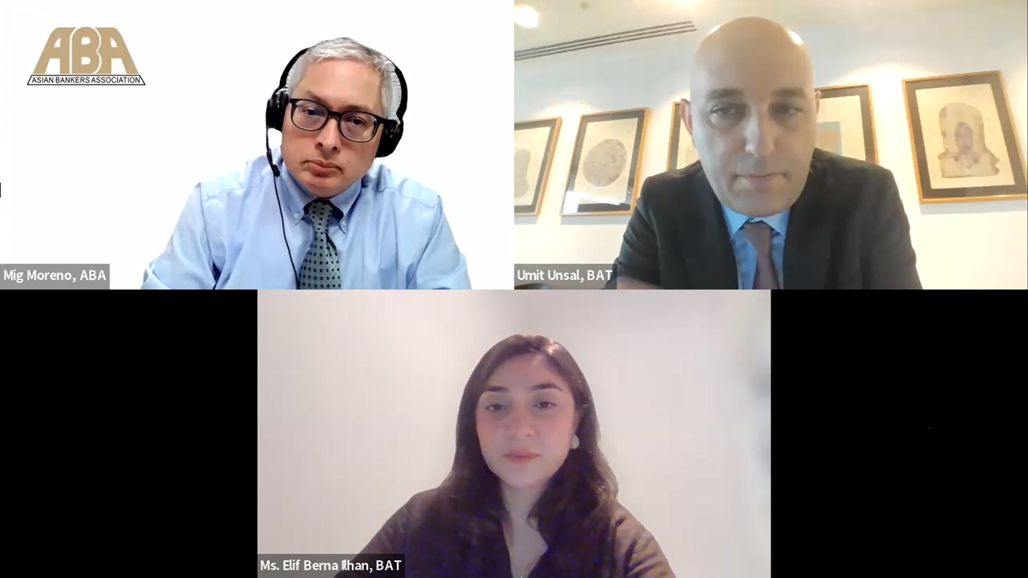
 The Asian Bankers Association (ABA) and The Banks Association of Türkiye (BAT) presented a webinar on "Türkiye’s Economy – Banking Outlook & COP31 Vision" on 13 August 2026. Participants from more than 10 countries had the opportunity to observe the latest statistics of the Turkish economy. Among the many issues discussed, the inflation situation was of critical importance.
Hereunder is the summary of the presentations made during the webinar.
(1) Introduction
In his opening remarks, moderator Mig Moreno, Deputy Secretary-Treasurer of the ABA, highlighted Türkiye’s strategic position between Europe and Asia and its importance to regional economies and markets.
He introduced Ümit Ünsal, Coordinator of Research, Statistics & Sustainability at BAT, who discussed Türkiye’s economy and banking sector, and Elif Berna İlhan, Sustainability Specialist at BAT, who would present Türkiye’s COP31 preparations and the role of the banking industry in the green transition.
The webinar concluded with an interactive Q&A session.
(2) Türkiye’s Economic and Banking Outlook by Ümit Ünsal
Ümit Ünsal described Türkiye as a diversified economy with a young population, strong industrial base and strategic geographic position, while noting that recent economic policy has focused on reducing inflation, improving external balances and creating a more predictable economic framework. Türkiye’s economy grew 2.5% in the first quarter of 2026, below its estimated long-term potential growth rate of 4.5–5%, largely because of tighter monetary conditions and external uncertainties.
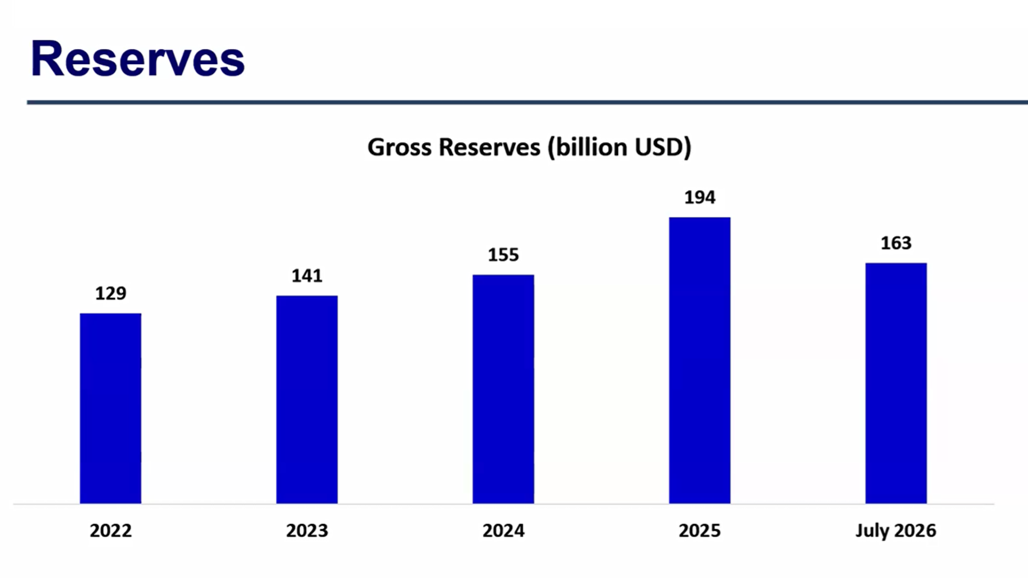
Inflation remained the principal challenge. After the CBRT raised its policy rate to 50% in 2024, declining inflation allowed the rate to be reduced to 38% by the time of the webinar. Authorities were also using reserve requirements, credit-growth limits and Turkish-lira deposit targets to control liquidity and reduce dollarization. Meanwhile, international reserves had strengthened, the budget deficit had fallen to approximately 2.2% of GDP, and Türkiye maintained relatively low levels of household and corporate indebtedness.
Ünsal said Türkiye’s banking industry remained fundamentally resilient. The sector had approximately US$1.1 trillion in assets, with deposits providing its main source of funding. The Turkish-lira share of deposits had recovered to about 61%, while the non-performing loan ratio remained manageable at approximately 2.9%. Capital adequacy stood at about 16.6%, comfortably above regulatory requirements. Although profitability remained under pressure—with return on equity around 26% compared with inflation of 31%—the sector remained well-capitalized and positioned to benefit from continued disinflation and improving economic stability.
(3) COP31 Vision by Elif Berna İlhan
Elif Berna İlhan explained that Türkiye intends COP31 in Antalya to be an “implementation COP”, moving the climate agenda from commitments toward measurable results. Türkiye’s approach is built around three principles: dialogue, consensus and action. Its broader green transition program includes a national climate strategy, emissions trading initiatives and increasing alignment with international climate policies, all of which will require substantial investment and financing.
A central initiative is the Climate Implementation Bridge, designed to connect climate commitments with investment-ready projects and available financing. İlhan emphasized that banks are essential to this process because climate change creates both new risks and significant financing opportunities in renewable energy, green finance and industrial transformation. BAT is preparing a Türkiye Sector Sustainable Finance Outlook Report, engaging policymakers and international stakeholders, and serving as a Strategic Partner for Finance of the COP31 Presidency. She stressed that COP31’s success will ultimately depend on translating agreements reached in Antalya into investment and concrete action afterward.
(4) Q&A Session
The Q&A focused primarily on inflation, asset quality, banking profitability and the sector’s response to tighter financial conditions. Ünsal explained that banks were relying mainly on higher provisioning and loan restructuring to manage borrowers facing economic pressure. He expected inflation, which had fallen from around 70% in 2024 to approximately 31%, to decline below 30% by the end of 2026, below 20% in 2027 and eventually return to single digits. As inflation declined, customers were also moving savings back from US dollars, gold and real assets into Turkish-lira deposits.
İlhan said BAT was preparing several COP31 activities, including a proposed finance-focused panel in the Blue Zone. On the banking outlook, Ünsal said lower inflation should strengthen balance sheets, improve profitability and support capital formation. Asset-quality risks among SMEs and retail borrowers remained manageable, while Turkish-lira deposits represented approximately 62% of total deposits.
Both speakers concluded by emphasizing stronger cooperation between Turkish and Asian banks, including opportunities for future collaboration around COP31, trade, investment and sustainable finance.
A copy of the presentation file is available to ABA members only.
The video recording of the session is available at the ABA YouTube channel.